Why Do I Say Yes When I Mean No? The Subconscious Beliefs Behind People-Pleasing

Say yes. Resent it. Do it anyway. Promise yourself you’ll say no next time. Repeat.

If you keep asking yourself why you say yes when every part of you is screaming no, there’s a reason. And it’s not because you’re weak or bad at boundaries.

I know this one well. I spent years as a people pleaser who pushed herself to the limit. There was an unspoken knowing that, as a woman in corporate, I had to work even harder to prove myself and be taken seriously, particularly to move through the ranks. And I believed you kept pushing through no matter how you felt, or you were a failure. Looking back, it’s no wonder I kept landing in a heap.

If you’re new here, start with Why Do I Keep Burning Out? The Subconscious Beliefs Behind It. This post goes a layer deeper into the people-pleasing side of it.

Signs you might be a people pleaser

It’s not always as obvious as you’d think. You might recognize a few of these:

  • You say yes before you’ve even checked whether you want to
  • You apologize a lot, even when it isn’t your fault
  • You agree with people to keep the peace, even when you don’t
  • You take on more than your share at work or at home, then resent it
  • You find it hard to ask for help
  • You feel guilty the moment you say no
  • You worry about what people will think if you change your mind
  • You’re exhausted, but still say “sure, no problem”

If you nodded at more than a couple, you’re in good company. And there’s a reason behind it.

Why is it so hard to say no?

Because boundary advice deals with what you do. It doesn’t touch why you do it.

You can read every article on saying no. You can practice the script in the car. But if there’s a belief running underneath that says “they’ll think badly of me,” your mouth says yes before your brain catches up. (Sound familiar?)

Why do we become people pleasers?

Most people pleasers didn’t choose it. It’s a pattern picked up long ago, usually as a way of staying safe, liked and included. Maybe it paid off to be the helpful one, the easy one, the one who never caused any trouble. Maybe work taught it too, where doing more and being agreeable got rewarded.

We soak up a lot as kids, and as you’ll see below, much of our belief blueprint is set by around the age of 7. So a pattern that kept you safe back then, or kept the peace later on, can keep running long after you stopped needing it.

It worked, which is exactly why it stuck. The pattern was doing a job. It just costs you more than it gives you now.

What are subconscious beliefs?

You’ve got two layers going on. The conscious part of you makes decisions and reads articles like this one. The subconscious part runs quietly in the background, on beliefs you picked up long ago, often without ever choosing them. They came from family, school, work and the people around you, and they run on autopilot.

Cell biologist Dr. Bruce Lipton, author of The Biology of Belief, says that around 95% of the time our subconscious mind is running the show, with just a measly 5% coming from our conscious mind. He also says that pretty much everything we see, hear, feel or are exposed to up to around the age of 7 becomes our belief system blueprint. And let’s not forget generational beliefs and trauma.

So you can know, logically, that you’re allowed to say no. But the belief underneath hasn’t got the memo.


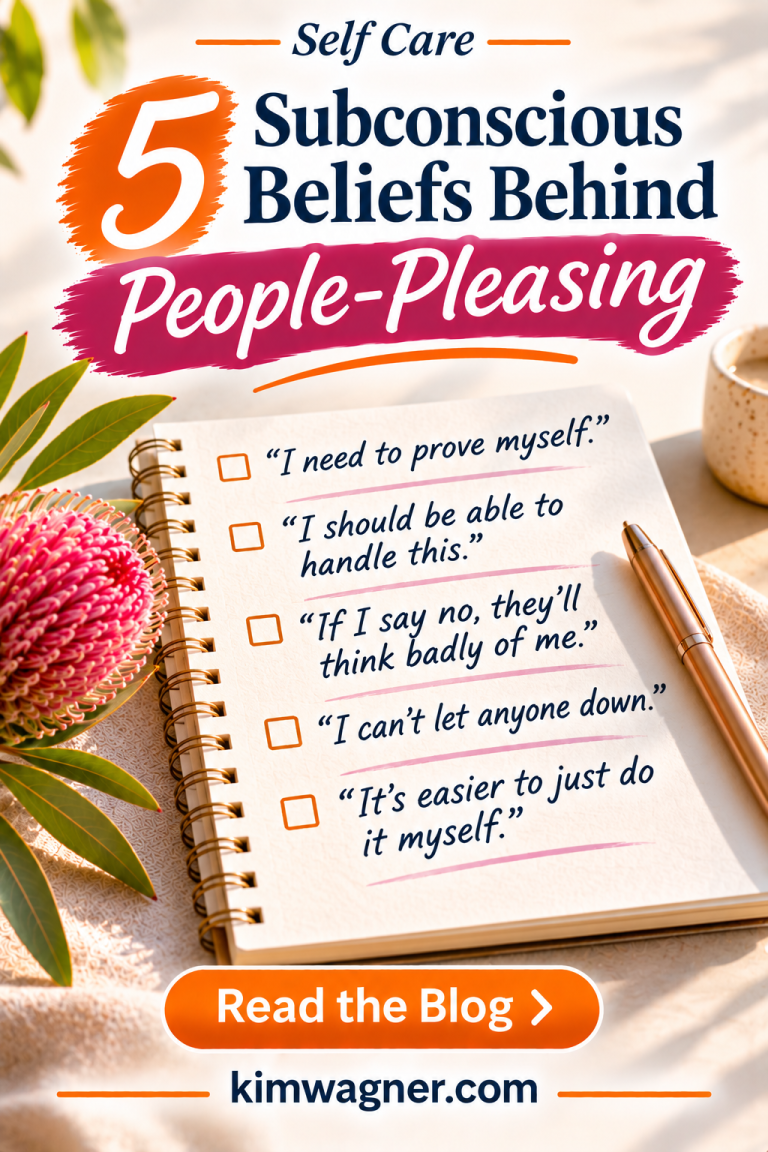
5 subconscious beliefs behind people-pleasing

These are just five of the many that can be lurking in there.

1. “I need to prove myself.”

So you say yes to the extra project, the extra favor, the extra everything. You stay late. You over-deliver. And somehow it’s never quite enough, because you can’t out-achieve a belief that says you have to keep proving it.

2. “I should be able to handle this.”

Asking for help feels like failing. So you take it all on, smile, and say “no worries, I’ve got it.” (You don’t. You’re running on fumes.)

3. “If I say no, they’ll think badly of me.”

You’d rather be exhausted than be the one who let someone down. Even a small no feels like a big risk.

4. “I can’t let anyone down.”

Everyone else’s needs come first, every time. You’re the dependable one. The one everyone can count on. Except yourself.

5. “It’s easier to just do it myself.”

So you do. All of it. And then you wonder why you’re so tired and nobody else seems to notice.

If you’re not sure where you land, my Boundaries ebook is a good place to start.

Want help getting to the bottom of yours? This is exactly what I do with PSYCH-K: finding the beliefs that are running the show and updating them. See how it works.

Why you can’t just think your way out

I wish it were as simple as telling yourself “I’m allowed to say no.” But the belief sits below your conscious mind, so a pep talk doesn’t reach it. You can say the right words all day, and the old programming still wins.

That’s why the usual advice (just say no more, just set boundaries) helps for a day and then fizzles. It’s dealing with the surface, and the pattern is sitting underneath.

What you can do about it

We’re all different, so treat these as starting points, not set in stone.

  1. Notice the yes reflex. Catch the moment before you answer. What did your body do? What thought showed up?
  2. Ask where it came from. Whose voice is that? Where did you learn that saying no makes you difficult?
  3. Question whether it’s true. Would your people really think badly of you? Or is that an old rule?
  4. Try one small no this week. Something low-risk. See what actually happens. (The world doesn’t end.)
  5. Get support to change it. Sometimes you can’t shift a belief by yourself, because you can’t see the water you’re swimming in.

How I help with this

This is the work I do with PSYCH-K: finding the beliefs that are running the show, and updating them so saying no stops feeling like such a big deal. If you’d like to understand how it works, check it out here.

My PSYCH-K sessions are for anyone who is ready to change their subconscious beliefs, the limiting beliefs and old patterns holding them back. Sessions are online, so you can do them from wherever you are.

Ready to find out what’s holding you back? You can book a free discovery call here. No pressure, just a chat.

Not ready to book yet? Grab my free guide, 7 Signs You’re in Burnout, and find out where you’re at in a few minutes.

If your people-pleasing feels tied to something heavier, like long-term low mood, anxiety or past trauma, please also talk to your GP or a counselor. Belief work sits alongside that support, not in place of it.

Common questions about people-pleasing

Why do I feel guilty when I say no?

Because the belief underneath says that saying no is risky: that you’ll let someone down or be thought badly of. The guilt is the old programming reacting. It isn’t proof that you’ve done something wrong.

Can you stop being a people pleaser?

Yes. It’s usually less about trying harder and more about changing the belief underneath. When that belief shifts, saying no tends to feel a lot less scary.

Is people-pleasing the same as being kind?

No. Kindness comes from choice. People-pleasing comes from fear of what happens if you don’t. You can be generous and caring and still say no.

How do I start saying no without the guilt?

Start small. Pause before you answer, and try “let me get back to you.” That gap gives you time to check in with what you actually want, rather than defaulting to yes.

The bottom line

You’re not difficult, and you’re not broken. You’ve been dependable for a very long time, running on beliefs you never chose. Notice them, question them, and get support to change them. That’s how you stop the cycle and start feeling like yourself again.

If this resonated, know it doesn’t have to stay this way. I work with high-achieving women who are done running on empty and ready to optimize their health, feel like a million bucks, and actually thrive, not just get by. Book a free discovery call here and let’s talk, no pressure, just a real conversation about what’s going on for you.

Until next time,

Kim Wagner is a certified Self Care Coach, IIN Health Coach, Menopause Coach, PSYCH-K® Preferred Facilitator, and Amazon bestselling author.

This post is for educational and informational purposes only and is not intended as medical advice. I’m not a doctor, and nothing here should replace a conversation with your GP or qualified healthcare provider, especially if you have a diagnosed condition or are taking medication. Always check with a professional before making changes to your diet, supplements, or health routine.