Wide Awake at 3am? The Evening Wind-Down for Burned Out Women

You’re exhausted all day. Knackered at bedtime. Then BAM, wide awake the second your head hits the pillow.

Or you drop off fine, and then it’s 3am and your brain is running like a freight train – and honestly, everything seems like it’s a catastrophe!!

If that’s you, you’re definitely not alone. I spent years running on fumes in corporate finance, wired and wrecked at the same time, so I know how it feels when your body won’t switch off even though you’re desperate for sleep.

If you haven’t yet, read How to Calm the Nervous System When you Can’t Switch Off first. This is the practical follow-up.

Want a quick reset you can do first thing in the morning that takes just 5 minutes? Grab my Cortisol Reset guide 

Better habits matter, but your body needs backup too. That’s why I pair my routine with a 100% natural activator, built on 25+ years of science. 

Why you’re wide awake when you’re so tired

When your body has been in go mode for months or years, it doesn’t switch off just because the clock says bedtime, or you simply decide you’re ready to relax. Your nervous system is still on high alert (fight or flight anyone?!), your mind is still running like crazy and won’t switch off, and sleep is simply not going to happen.

Spoiler alert: this sounds a lot like burnout and let me tell you, this shit is real. Years of running on empty puts real stress on your body, including at the cellular level. That’s why supporting my body became part of my reset, starting with a 100% natural activator backed by more science than you can poke a stick at.  

The good news is that your evenings are one of the easiest places to start. You don’t need to change everything at once, but working on your nighttime routine will help your body know the day is done.

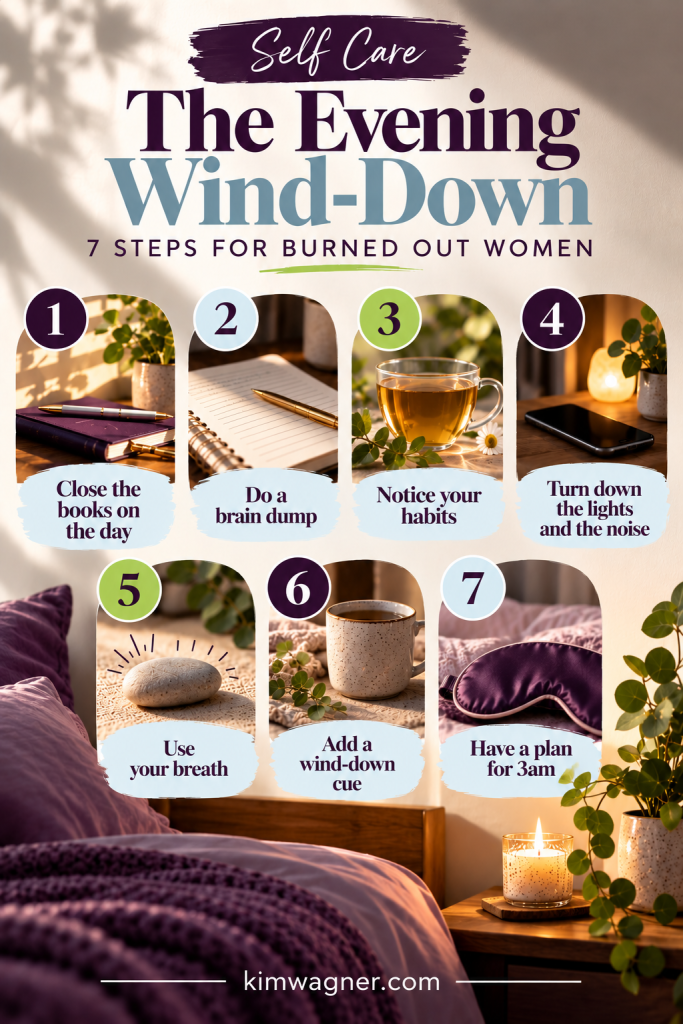
The evening wind-down: 7 steps

Remember, we’re all different, so treat these as starting points, not set in stone. Pick one or two to start. Please don’t turn this into another to-do list.

1. Close the books on the day

After 30 years in corporate finance, I think of it like month end. At a set time each evening, the day is closed. No more emails, no more “just one more thing.” Anything that’s left goes in tomorrow’s column.

Struggling to actually close the day? Saying no to “just one more thing” is a skill, and I’ve put together a guide to help: Boundaries ebook.

2. Do a brain dump

Grab a notebook and write down everything swirling around: tomorrow’s tasks, the things you’re worrying about, the thing you’ve been meaning to do. Getting it out of your head and onto paper gives your brain permission to stop running it at 3am. Bonus points if you don’t do the brain dump on a device. Go old school and use pen and paper. I keep a notebook beside the bed in case random stuff pops into my thoughts during the night.

3. Notice how you’re coming down

Caffeine to get going, then wine, snacks or flaking out on the couch to wind down. Remember… no judgment, just notice it. Maybe move your last coffee earlier, or swap one evening drink for herbal tea and see how you feel. This is about noticing your habits and seeing what small tweaks you can make.

4. Turn down the lights and the noise

Dim the lights, put the phone in another room and skip the doom scroll. If your phone is within reach, you’ll end up on it. If you must be on a device, put it into night mode and reduce the blue light that is emitted. Pick one thing to dial back tonight, not everything.

5. Use your breath

Breathe in for four, then out slowly for six or eight, a couple of minutes. Or take your shoes off and get your feet on the ground for a few minutes. Your body responds to signals of safety, not to a pep talk. I you use a grounding mat under my feet in the evening to help with this.  It makes a huge difference to how much I can wind down.

If you want the full picture of why this works, I explain it in How to Calm the Nervous System When You Can’t Switch Off. 

6. Add a wind-down cue

Same time, same small ritual every night: a herbal tea, a warm shower, a few pages of a book. Personally I have a herbal tea after my warm shower and try to read a chapter per night. After a few nights, the cue itself starts telling your body it’s time to settle.

I’ve pulled together everything I use in my own routine here: My Wellness Routine: The Things I Actually Use (And Love!).

I sleep on an earthing mat and it’s made a big different in how I wind down, sleep and feel the next morning.  To me it’s non negotiable.  Check it out here

7. Have a plan for 3am

If you wake up, don’t grab your phone and don’t start solving problems. Breathe out slowly, a few times. Remind yourself: “Tomorrow’s list is written down. I don’t have to do anything right now.” It’s a small thing, and it stops the spiral. And if it’s something actually important, jot it down in the notebook beside your bed.

Want the shortcut? Inside my Self Care: The Freedom Project program, I walk you through resetting your body and your mindset step by step, without adding more to your to-do list.  

What if it keeps happening?

You can do every one of these and still wake at 3am a couple of weeks later. That’s likely because there’s something underneath keeping your body on alert.

For a lot of the high-achieving women I work with, it’s a belief running in the background:

  • If I switch off, I’ll drop a ball.
  • Someone has to stay on watch.
  • I can’t rest until everything is done.

Those beliefs live in the subconscious, so your body keeps acting as if the job isn’t finished, even at 3am. That’s the work I do with PSYCH-K : finding and updating those old beliefs so your body can finally stand down.

One more thing: if you’re struggling with sleep over a long period, or it’s affecting your health or daily life, please check in with your GP. Sleep trouble can have lots of causes, and it’s best to get medical advice.

The bottom line

You don’t need the perfect routine. You need to give your body a few small signals, every evening, that the day is done and you’re safe.

Start with one step tonight. Then add another next week. Little by little, the 3am wake-ups lose their power.

Rest and routine matter, but your body also needs support while it comes back into balance. For me, that meant pairing rest with that same 100% natural activator. 

If this resonated, it doesn’t have to stay this way. I work with high-achieving women who are done running on empty and ready to optimize their health, feel like a million bucks, and actually thrive, not just get by. Explore the Self Care Program or Get in touch here and let’s have a real conversation about what’s going on for you.

Until next time,

Kim Wagner is a certified Self Care Coach, IIN Health Coach, Menopause Coach, PSYCH-K® Preferred Facilitator, and Amazon bestselling author.

This post is for educational and informational purposes only and is not intended as medical advice. I’m not a doctor, and nothing here should replace a conversation with your GP or qualified healthcare provider, especially if you have a diagnosed condition or are taking medication. Always check with a professional before making changes to your diet, supplements, or health routine.

Some of the links in this article are affiliate links. That means if you choose to purchase through my link, I may earn a small commission at no extra cost to you. I only share products and programs I personally use, love, or believe will genuinely help you thrive.